On most weekends I retreat to my office and “commune with the ancestors.” Our communion might involve scanning photos or picking up loose threads in my family tree. Last weekend, it was the latter and I found myself working my way through the Clay family. On reflection, I’m not really sure how I got there but I’ve spent the entire week exploring branches on the family tree and making one exciting discovery after the next.
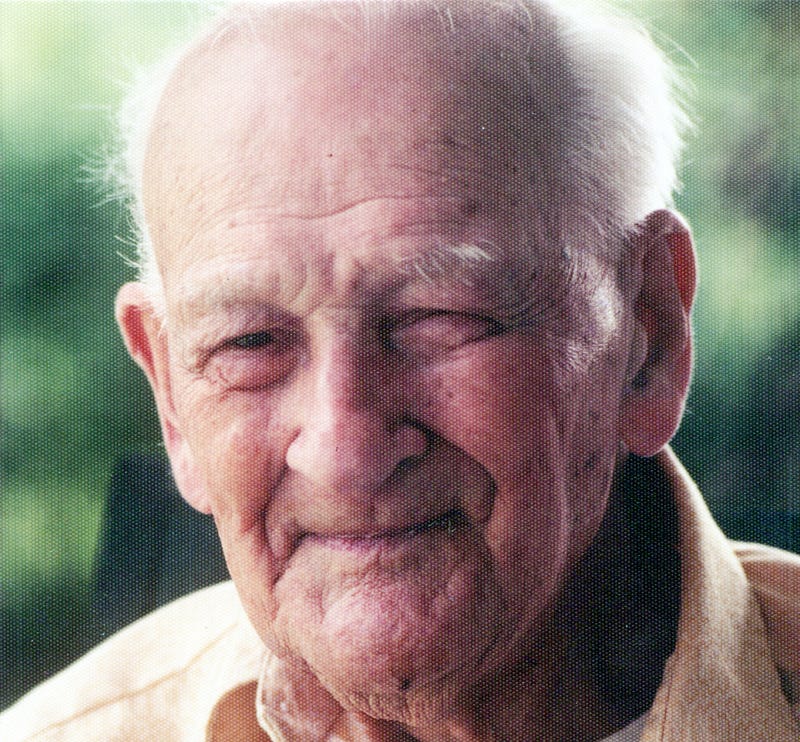
Last Sunday afternoon, I texted my family to say that I was pretty sure that we were related to Henry and Cassius Clay and I wish that I could tell my great-grandfather, Curtis Burnam Ledford, the patriarch of an expansive family and the subject of the book Generations: An American Family. And then I realized that Grandpa was giggling at me. Whenever I research his line, I turn to the book to see if his stories can provide context. Sure enough, he had mentioned Henry and Cassius Clay several times and suggested that there might be a kinship though he didn’t have the precise links.
In the book Grandpa says:
Not far from where Sam and Polly Jones lived on Coon Branch, my other grandfather, James Ledford, had a large tract of land. His house was just one valley and across a ridge away, right where Cranks Creek and Martins Fork join. He and my grandmother were divorced, and she was living in Virginia, and he was just before moving to Powell County. That grandmother’s name was Polly too — Polly Farley. I already told you about her. Her mother was Lavinia Clay-they called her Vinie. She was a daughter of John Clay, who was some kin to Henry or Cassius one. I always heard that John and Cassius were brothers. You know, old Green Clay, Cash’s father made a big land survey down through Kentucky and Tennessee, had thousands of acres, and they said John settled on part of it there in Harlan County. When I was about six years old, Cassius Clay came to Harlan to see some of his kinfolks, and one night he stopped to visit my father and stayed all night at our house. He and my father stayed up past midnight, just sitting by the fire talking, and I wanted to stay up and listen to them, but I got so sleepy I couldn’t keep my eyes open. He was an old man, then, Cash was-but I met him twice more after that. John Clay was already dead when Cassius came to our house that time. He had been shot from ambush and killed by a fellow named Carr Clem, way back before the Civil War. They arrested Clem and hung him. I remember one of my grandfathers telling me that story.In another section of the book he says:
If I had been older, maybe I would have been influenced more by Cassius Clay. He lived at White Hall, outside of Richmond, not far from our farm, and he had given land to start Berea College for young people and poor people, white and black. I thought Clay was a great man — I liked him very much. He had stayed at our house in Harlan County when I was a small boy, and I always believed he was a brother to John Clay of Harlan County, whose daughter Lavinia was my great-grandmother. I never could prove that, though.C.B. Ledford, my great-grandfather
John Edgerton, the author of Generations, started researching the book and talking with my family in 1978. He took the stories handed down from Grandpa and Grandma (Addie King Ledford) and verified records where he could. As far as I know, he didn’t attempt to make any connections with the Clay family. He focused primarily on the story of Aley Ledford, the progenitor of our Ledford line, and his descendants.
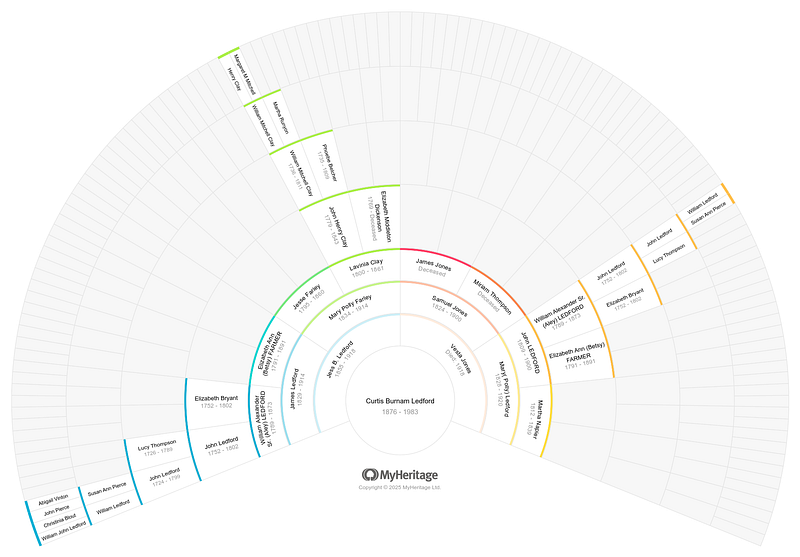
Henry Clay had a storied political career. He was a U.S. Senator and Secretary of State and was known as the “Great Compromiser.” He also had an instrumental role in the founding of the Whig and Republican Parties (something tells me he’s rolling over in his grave right about now). Cassius Marcellus Clay, Henry’s cousin, was also a prominent politician. He was a slave-owning abolitionist who survived multiple assassination attempts. He served in the Mexican American War and the US Civil War and was appointed to serve as the US Ambassador to Russia. He also donated the land to establish what would become Berea College. This entire branch of the Clay family figured prominently in Virginia and Kentucky politics for generations.After finding some tenuous connections to ol’ Henry and Cassius, I traced their ancestors as far as I could. Along the way, I stumbled on the Clay Family Society and numerous stories of pioneering Clays who left Virginia to settle Kentucky. Let me say here, that it helps to have a famous ancestor whose genealogy has already been done for you! Once I found Cassius and Henry’s common ancestor, I started carefully working my way back through Lavinia Clay’s line and, sure enough, the connection was there.
Lavinia, Cassius, and Henry all descend from Henry Clay (1672–1760) and Margaret Mitchell (1693–1777). Henry’s grandfather, John Thomas Clay (1587–1655), was our immigrant ancestor, arriving in Jamestown around 1613. The line is fairly maddening to trace because nearly every generation has a John and a Henry and they all hailed from Virginia.
I don’t know whether to be more impressed by the availability of online archives or the power of storytelling. Just kidding, I’m way more impressed with Grandpa’s mind and the importance that he placed on remembering and honoring his connections to the past.


No comments:
Post a Comment