The photo above is the title from a 1995 issue of The Kentucky Explorer. Dillion Blevens Asher is my five times great-grandfather. And while he did run one of the first toll houses in Kentucky, that's probably the least interesting thing about him.
I've been working on a series of posts that take unanswered questions or loose ends from Generations: an American Family and either attempt to answer the questions or tie up the ends. This post started because Addie King Ledford, my great-grandmother, mentioned in the book that her great-great grandfather was a Revolutionary War soldier. I wanted to find out more about his service so I started to dig through the archives. I didn't find a soldier but I did find a polygamist. When you start digging up the past, you have to be prepared to confront stories that conflict with your previous understanding of things, that turn your family history on its head. And when you find those stories, you have to decide whether you want to keep them buried, bring them to light, or twist them into a different kind of narrative that suits you better. I tend to shine a light on everything I find so, let's shine some light on Dillion Blevens Asher.
Addie had this to say about Dillion:
Margaret Farmer, my grandmother - they always called her Peggy, or Peg - was Jim Farmer's daughter, old Surveyor Jim. Jim was married to Margaret Asher, the daughter of a Revolutionary War soldier named Dillon Asher. She was just eighteen years old when she died giving birth to my grandmother. The baby was named Margaret after her mother and was raised by her grandparents, old Dillon Asher and his wife. Jim Farmer got married again-to Susan san Skidmore, Abram's sister-and they had eleven children.
John Egerton. Generations: An American Family (Kindle Locations 488-491). Kindle Edition.
In attempting to track down the Asher line, I came across a family genealogy titled “Asher 1700-2000: A Family History” written by Charles H. Asher. After reading and rereading the text, I feel confident that Dillion’s father was William Asher, Jr. Beyond that, I’m fairly confused even with the assistance of Ancestry. There are too many William’s and John’s with no birthdates to help distinguish between the generations and the names of their wives appear to be lost to history. Don’t even get me started on that last part.
With all the uncertainties, what I do feel confident in saying is that the Asher family was in Virginia in the early 1700’s, they held vast amounts of land, they fought in the Revolution, and we are their descendants.
The story that Addie didn’t tell (or didn’t know) about Dillion is far more interesting than if he had been a revolutionary soldier. I had always heard about the possibility of polygamy and lots of children but nothing more than that. The Asher history dives into that story. The author of the book quotes conversations and doesn’t clarify whether these are oral tradition or known facts so I can only present them to you with a link (above) to the original document and a shrug.
William Asher, Jr. drowned in the Halston River in about 1792 while chasing a deer. Dillion was 15 at the time. This tragic event makes me all the more grateful that there is a Meijer less than one mile from my house and that I’ve ever needed to wade into a river to get there. One can only assume that the care of William’s children fell to his wife along with various family members. This becomes more obvious as we find out that Dillion and his uncle Dillion Blevens, joined a party that met at Fort Boonesboro and then traversed Straight Creek, Red Bird Creek, and the Kentucky River.
Dillion fell in love repeatedly on this trip. The first time was with the land.

The second was with a young woman. On their way home from scouting, the party stopped at the home of Richard Davis. There, Dillion met Richard’s daughter, Mary, and fell in love with her. Dillion and Mary wed and soon he was appointed as the first toll-gate operator in Kentucky. After a time, Dillion decided to return to the area around Red Bird Creek Valley because, as the Asher book notes, he wanted to check on those peach seeds. Mary was not too keen on the move and, in her defense, I’d need more impetus to move to an isolated wilderness than a fond memory of planting peach pits that may or may not have taken root. Dillion wouldn’t give up on the idea though and, apparently (?!) Mary said that she would move but only if they could take her sister, Sally.

I’m trying not to judge either Dillion or Mary here but I’ve got big questions about Mary’s negotiation tactics and Dillion’s interpretational skills. In no world would, “I’ll go but only if we take my sister” would the word take mean anything more than accompany. In this account, we jump from traveling partner to polygamy in the space of one sentence.
With all the uncertainties, what I do feel confident in saying is that the Asher family was in Virginia in the early 1700’s, they held vast amounts of land, they fought in the Revolution, and we are their descendants.
The story that Addie didn’t tell (or didn’t know) about Dillion is far more interesting than if he had been a revolutionary soldier. I had always heard about the possibility of polygamy and lots of children but nothing more than that. The Asher history dives into that story. The author of the book quotes conversations and doesn’t clarify whether these are oral tradition or known facts so I can only present them to you with a link (above) to the original document and a shrug.
William Asher, Jr. drowned in the Halston River in about 1792 while chasing a deer. Dillion was 15 at the time. This tragic event makes me all the more grateful that there is a Meijer less than one mile from my house and that I’ve ever needed to wade into a river to get there. One can only assume that the care of William’s children fell to his wife along with various family members. This becomes more obvious as we find out that Dillion and his uncle Dillion Blevens, joined a party that met at Fort Boonesboro and then traversed Straight Creek, Red Bird Creek, and the Kentucky River.
Dillion fell in love repeatedly on this trip. The first time was with the land.
The second was with a young woman. On their way home from scouting, the party stopped at the home of Richard Davis. There, Dillion met Richard’s daughter, Mary, and fell in love with her. Dillion and Mary wed and soon he was appointed as the first toll-gate operator in Kentucky. After a time, Dillion decided to return to the area around Red Bird Creek Valley because, as the Asher book notes, he wanted to check on those peach seeds. Mary was not too keen on the move and, in her defense, I’d need more impetus to move to an isolated wilderness than a fond memory of planting peach pits that may or may not have taken root. Dillion wouldn’t give up on the idea though and, apparently (?!) Mary said that she would move but only if they could take her sister, Sally.
I’m trying not to judge either Dillion or Mary here but I’ve got big questions about Mary’s negotiation tactics and Dillion’s interpretational skills. In no world would, “I’ll go but only if we take my sister” would the word take mean anything more than accompany. In this account, we jump from traveling partner to polygamy in the space of one sentence.
Whether this was a negotiation gone wrong for Mary, a faulty narrator, or Dillion was just icky (or somewhere in between) we’ll never know. What we do know is that Dillion built houses for both Mary and Sally, fathered at least 16 children between them, and they created a descendancy that is still alive and well in southeastern Kentucky and throughout the country. The first of the two log cabins that Dillion built still stands today in Beverly, Kentucky on the grounds of what is now the Red Bird Community Hospital.
In 1984 The Sentinel Echo in London Kentucky published a brief history of the Asher family written by Sadie W. Stidham. Ol' Sadie leaned heavily into the "rewrite the narrative" version of family history as evidenced by the excerpt below.
Dillion I, son of William and Blevens Asher, was born in England in 1774. He married an English girl by the name of Mary Davis (born in 1775). Mary was the daughter of Richard and Elizabeth Preston Davis. Shortly after coming to America, Mary died and Dillion I married her sister, Sally (Sarah).
It does feel a little more comfortable to tell the story this way but I have read nothing that would support any of the facts presented other than the names. Dillion's family was in the colonies long before his birth and it's clear from the birth records that Dillion was fathering children with both women at the same time. How very Nick Cannon of him!
Our family descends from Margaret Asher, daughter of Dillion and Nancy Davis. Margaret married James (Jim) Farmer and, according to Addie, Margaret died in 1830 at 18 years old giving birth to her grandmother, Margaret Farmer. Addie also says that the young Margaret was raised by “old Dillon and his wife” though she did not specify which one.
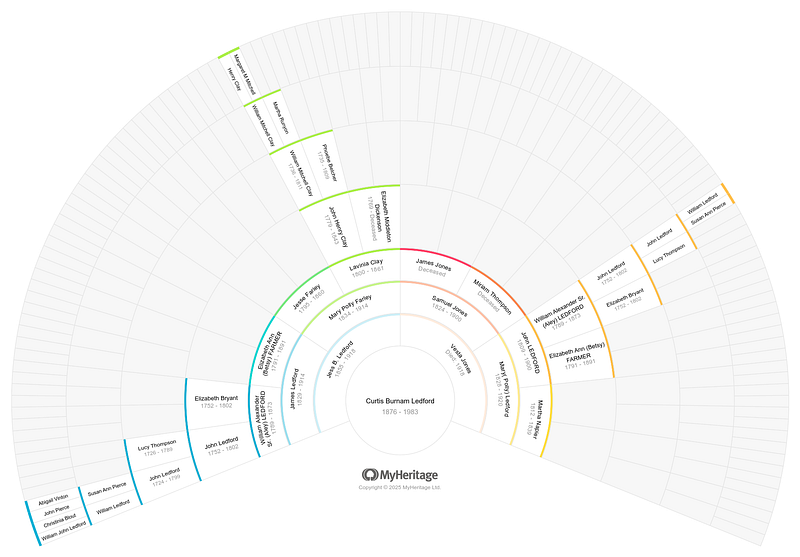
Below is my ancestral connection to Dillion.
 |
| from Ancestry.com |
Margaret Farmer married Abraham Skidmore (1865-1939) in 1846. Their daughter, Polly Skidmore, married Ewell Vanderbilt King (1858-1893) and these are the parents of Addie King Ledford.
Dillion died in 1844, 41 years before Addie was born. Margaret Farmer, Addie's grandmother was raised by Dillion so she would have surely been aware of the situation. Did polygamy not register as out of the ordinary and, thus, not get passed down in our oral traditions or did it just get conveniently omitted from the stories? We'll never know for sure, but it's interesting to speculate.